A.J. Wright
Librarian, Anesthesiology Department,
University of Alabama at Birmingham
Unless there are issues of contamination or supply, blood typing, banking and transfusion seem to us today to be standardized and safe medical procedures. Like so many developments in medicine and the sciences, however, the idea of blood transfusion and its early attempts long predate practical application.
Thinking about blood and the history of medicine might bring to mind two subjects: William Harvey and bloodletting. In 1628, Harvey published his De Motu Cordis, also known as “On the Motion of the Heart and Blood.” In this work of only 72 pages, he outlined the heart’s action and the circulation of blood through the body. He developed this work from painstaking research on animals such as eels, fish and snails, using a single magnifying lens.

Vignettes, in decorative oval borders, showing blood transfusions from animal to human; and from a healthy person and a sick person, arm to arm; and hand to hand. Mercklin, Georg Abraham, 1644-1702.
Image published in 1679. Source: U.S. National Library of Medicine
Bloodletting resulted from the ancient medieval theory of “humors” in which good health depended on a balance of bodily fluids, including blood. This very common practice survived in some places almost 2,000 years, well into the late 19th century.
The role and use of blood in a medical or health context is also ancient. The Roman poet Ovid described in his Metamorphoses how Medea gave youth to her father-in-law by replacing his blood with an elixir. Roman philosopher Pliny the Elder noted how spectators would drink the blood of dying gladiators to transfer strength and bravery to themselves. Blood has been a part of the rituals of many cultures over the centuries.
What qualifies as the first real attempted transfusion has been difficult for historians to determine. An ancient Hebrew manuscript describes curing the leprosy of the king of Syria by drawing out his blood and replacing it with blood from another person.
Often cited as the first blood transfusion is an event sometime in the early 1490s. An anti-papist lawyer in Rome, Stefano Infessura, who died around 1500, described the attempt in his Diary of the City of Rome. When Pope Innocent VIII was on his deathbed, a Jewish physician named Abraham Meyre suggested infusing blood from three 10-year-old boys into the pontiff’s veins. All three donors died and Innocent himself died on July 25, 1492. The Catholic Encyclopediawarned that Infessura’s work was full of gossip and not to be trusted. Most likely, if this event occurred, the pope drank the blood instead of it being transfused.
By the mid-17th century, more believable events in this story begin to appear in the historical record. An English vicar, Francis Potter, apparently altered quills and pipes to use in man-to-man blood transfusion as early as 1639. His work and further improvements were described in the writings of a friend, John Abery, but there is no evidence actual transfusion was attempted. Francesco Folli of Florence and a Benedictine monk, Robert des Gabets, also wrote about the transfusion idea in mid-century.

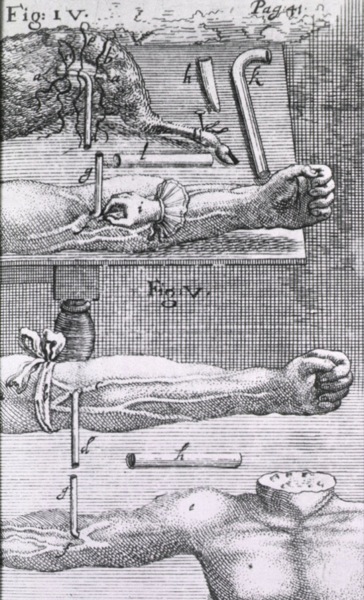
Elsholtz, Johann Sigismund, 1623-1688, author. Two views of blood transfusions: An animal and a human arm are on one table, the necessary tubular attachments for making the connections are shown extending from the arm and the animal’s side; the second view is of two arms with tubes as above.
Image published in 1667. Source: U.S. National Library of Medicine
At this time, real-life efforts at actual infusions and transfusions also began. Using small bird bones, the German Georg von Wahrendorff injected wine into the veins of hunting dogs and other substances into sick canines. Johann Daniel Major is believed to have given medications to humans intravenously, and also suggested a method of blood transfusion with a cannula made of silver.
Even better documented is work by two English greats, Christopher Wren and Robert Boyle. Wren demonstrated IV injections of various substances into dogs by means of an animal bladder and quills. Chemist and physician Boyle did similar experiments; ale, wine and opium were injected into dogs as early as 1656. Accounts by both men were published in the 1660s.
In May 1665, another physician, Robert Lower of Oxford, described an animal-to-animal blood transfusion in a letter to Boyle. This letter was read at a Royal Society meeting in September 1666, and Lower’s book Tractatus de Corde includes a description as well. The great diarist Samuel Pepys also noted Lower’s experiments. The technique, Pepys said, quoting an informant, “may, if it takes, be of mighty use to man’s health, for the amending of bad blood by borrowing from a better body.”
Also recorded by Pepys and in the Transactions of the Royal Society was Lower’s transfusion of animal blood into Arthur Coga on Nov. 22, 1667. Assisted by Dr. Edmund King, Lower used quills and silver pipes to convey blood from a sheep’s carotid artery into a vein in Coga’s arm. The following month, another transfusion was done, and Coga declared that he felt better. Pepys cryptically noted that Coga “is cracked a little in the head.”
Lower’s work on a human was preceded in Paris by just a few months. Physician and astrologer Jean-Baptiste Denis (sometimes spelled “Denys”) had performed the first blood transfusion involving a human on either June 15 or 28, 1667. The patient was a feverish young man on whom other doctors had employed leeches 20 times; after Denis transfused him with several ounces of either dog or lamb’s blood, he “rapidly recovered from his lethargy.”

Early blood transfusion from lamb to man (1705).
Credit: Wellcome Library, London. Wellcome Images
Denis used a similar method to supposedly cure a madman, and a few more experiments by scientists in France and London were deemed successful. Denis had first experimented with animal-to-animal transfusions; he published a letter in the Journals des Scavans describing his work. After one patient died, however, Denis was tried for murder. He was eventually exonerated because it turned out the patient’s wife had used arsenic to poison her spouse.
Also to be noted at this time was Johann Sigismund Elsholtz, a German botanist, physician and alchemist who worked in the court of Friedrich Wilhelm of Brandenburg. His book Clysmatica nova, published in 1667, describes the potential of IV injections and research on blood transfusion. He felt that the blood of a vibrant wife could help a husband with melancholy.
Members of the Faculty of Medicine in Paris were outraged by the work of Denis and others. They did not even recognize Harvey’s blood circulation theory, and condemned transfusions in print.
The pope banned the procedure in 1679, and the research so active in Europe between 1639 and 1667 essentially stopped for more than a century.
On Sept. 26, 1818, at Guy’s Hospital, the practice was revived in spectacular fashion. English obstetrician and physiologist James Blundell became the first to transfuse human blood into another human with equipment he designed. He had first conducted animal experiments. Although the patient in this initial attempt died two days later, Blundell continued his efforts in 10 patients, five of whom survived.
Almost a century would pass before Karl Landsteiner’s work on blood groups began the modern era of blood transfusion and led to everything we now take for granted about the procedure. That work was preceded by centuries of now-strange theories and fitful efforts to make blood transference possible and useful.

First page of article by James Blundell
Source: Wikipedia
Suggested Reading
- Learoyd P. The history of blood transfusion prior to the 20th century—Part 1. Transfus Med. 2012;22(5):308-314.
- Moore P. Blood and Justice: The Seventeenth-Century Parisian Doctor Who Made Blood Transfusion History(2003).